A – April(noun) 🌦️ The fourth month of the year, often associated with springtime weather.
B – Bloom(verb) 🌸 🌹 To produce flowers.
C – Cherry blossoms(noun) 🌺 The pink or white flowers of cherry trees, commonly seen in early spring.
D – Daffodils(noun) 🌼 Bright yellow or white trumpet-shaped flowers that bloom in early spring.
E – Easter(noun) 🐣 🐰 A spring holiday celebrating renewal and, in Christianity, the resurrection of Jesus.
F – Flowers(noun) 💐 🪻 The colorful, often fragrant reproductive parts of plants that bloom in spring.
G – Garden(noun) 🌻 🌱 🥬 A space for growing plants, flowers, or vegetables.
H – Honeybee(noun) 🐝 A flying insect that collects nectar and helps pollinate plants.
I – Insect(noun) 🪲 🐜 🪰 A small animal with six legs, a body divided into three parts (head, thorax, and abdomen), and typically one or two pairs of wings.
J – Jump(verb) 🤸 To push oneself off the ground into the air using the legs.
K – Kite(noun) 🪁 A lightweight object flown in the air on a string, often for fun on windy days.
L – Lamb(noun) 🐑 A young sheep, often born in spring.
M – Migration(noun) 🕊️ 🦆 The seasonal movement of animals, especially birds, from one region to another.
N – Nest(noun) 🪺 🐣 🪹 A structure built by birds to lay eggs and raise young.
O – Outdoors(noun) 🌳 🌲 🌞 The open air or natural environment.
P – Picnic(noun) 🧺 🍷 🥪 A meal eaten outside, especially in a park or natural setting.
Q – Quack(noun/verb) 🦆 (Noun) The sound a duck makes. (Verb) To make the sound of a duck.
R – Rainbow(noun) 🌈 Bands of colors in the sky caused by sunlight and rain.
S – Sunshine(noun) ☀️ Light and warmth from the sun.
T – Tulip(noun) 🌷 A brightly colored, cup-shaped flower that blooms in early to mid-spring.
U – Umbrella(noun) ☔ A tool used to protect yourself from rain or strong sun.
V – Vibrant(adjective) ✨ 🌸 🌈 Full of energy and life; bright and striking in appearance.
W – Warmth(noun) 🔆 A comfortable temperature, often associated with spring’s rising temperatures.
X – Xylem (noun) 🌱 Plant tissue that carries water from the roots to the rest of the plant.
Y – Yellow(adjective/noun) 💛 (Adjective) A bright color often seen in spring flowers. (Noun) The color itself.
Z – Zinnia(noun) 🌼 A bright, hardy flower that blooms in late spring and summer.
Americans talk about food, think about food, and eat food – a lot. It’s not surprising that so many expressions in American English are centered on food. Here are a few you will hear frequently:
Let’s start with our title – “It’s a piece of cake” means that something is easy to do. You might also hear the similar, “it’s easy as pie.”
Desserts are always good – eating them is a piece of cake!
“Spill the beans.”
Shhhh – don’t tell anyone you’re learning these idioms! “Spill the beans” is another way to say you’re telling a secret or giving away a surprise.
We didn’t want Luis to spill the beans about the surprise party for Dmitri.
“Cool as a cucumber.”
This means that someone is very relaxed and confident in a situation.
Maria went into the interview as cool as a cucumber.
“Bring home the bacon.”
This means you’re going to work and earning money, or you’re competing and win a prize.
Xiting worked hard all week to bring home the bacon for her family.
“Go bananas”
We use this idiom when we want to describe someone getting very excited about something – even acting a little crazy.
The crowd went bananas when Beyonce stepped onto the stage.
And let’s finish with another ‘sweet’ expression: “the icing on the cake.”
We say, “that’s the icing on the cake” when something good becomes even better when added to.
Ekaterina was happy to ice skate at the Olympics; winning the gold medal was the icing on the cake!
If you can use all these idioms, you’ll be the Big Cheese in your English class!
(“Big Cheese” means the most important person in a group.)
In celebration of Major League Baseball’s Opening Day on Thursday, March 26th, here are some key vocabulary & facts to know ahead of the 2026 season.
Baseball, sometimes called “America’s pastime”, is a team sport played between two teams of nine players each. The goal is to score more runs than the opposing team by hitting a ball and running around four bases to complete a run. A baseball game lasts for a minimum of nine innings – if the game is tied at the end of the ninth inning, the game continues until one team scores a run.
Basic Rules of Baseball
Teams take turns batting and fielding.
The batting team tries to score runs by hitting the ball and running around the bases.
The fielding team tries to get three outs to end the batting team’s turn.
A batter gets up to 3 strikes. Three strikes = out.
Four balls = walk (the batter goes to first base).
A run is scored when a player touches all four bases and returns to home plate.
After 3 outs, the teams switch sides (batting and fielding).
The game is played over 9 innings.
The team with the most runs at the end wins.
The Field
Diamond – The shape of the baseball field (infield), with four bases in a square shape.
Base – There are 4 bases: first base, second base, third base, and home plate.
Pitcher’s mound – The raised area in the center where the pitcher throws the ball.
Positions
Pitcher – The player who throws the ball to the batter.
Catcher – Crouches behind home plate to catch pitches.
Batter – The player trying to hit the ball.
Infielders – First baseman, second baseman, shortstop, and third baseman.
Outfielders – Left fielder, center fielder, and right fielder.
Key Vocabulary
catch, hit, pitch, run, swing
More vocabulary
Special Hits:
Single – The batter reaches first base.
Double – The batter reaches second base.
Triple – The batter reaches third base.
Home run – The ball is hit out of the field, and the batter (and any runners) score automatically.
A grand slam is a home run with the bases loaded (4 runs scored).
Ways to Get Out:
Strikeout – Three strikes.
Fly out – The ball is caught in the air.
Ground out – The ball is hit on the ground and thrown to first base before the batter gets there.
Tag out – A runner is touched with the ball while not on a base.
Force out – A runner has to move to the next base and is thrown out.
League & Teams
There are 30 Major League Baseball (MLB) teams. They are divided into two leagues: the American League and the National League, with 15 teams in each.
culinary — adj, relating to cooking or the kitchen
occurence — n., an event, something that happens
cozy — adj., providing contentment or comfort
various — adj., of an indefinite number greater than one
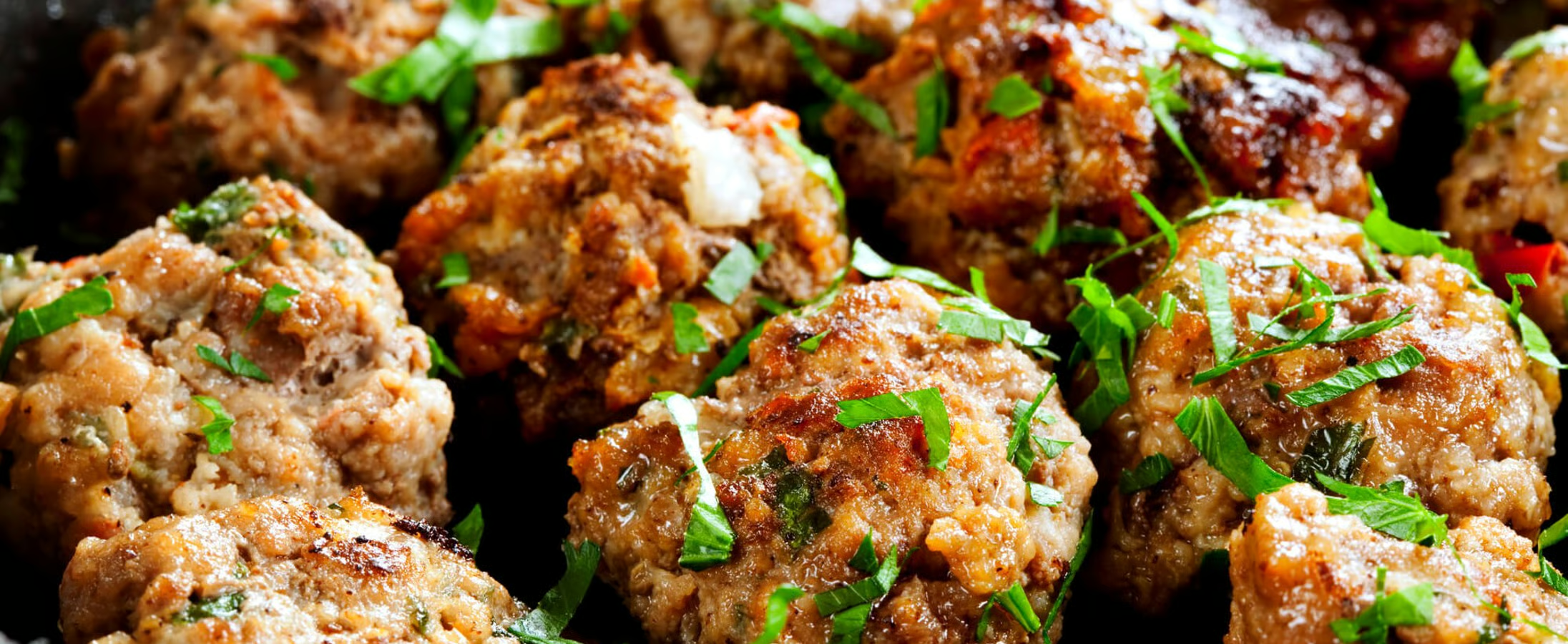
Juicy round balls of succulent meat, usually served with pasta, mashed potatoes or on their own — perfect for a cozy dinner at home!
Just the word, ‘meatball’ is enough to bring to mind great family meals for most people. These little balls of various meats can be found throughout the world in almost every culture.
Most people may associate them with Italian cuisine, though spaghetti and meatballs is actually an American dish. No matter your background, you can jump in and enjoy National Meatball Day!
How to Celebrate National Meatball Day
National Meatball Day, like other culinary holidays, should be enjoyed with your loved ones gathered around.
The most difficult part of preparing for National Meatball Day is going to be picking which nation’s recipe you will use. Luckily for you, this is a yearly occurrence, so you can pick a new nation to try each year if you like. Or you could be truly adventurous and try more than one at a time!
What is your favorite way to enjoy meatballs? There are so many ways to make them. Have you added them to your pizza or on a sandwich? Do you prefer to follow the traditions of your family or to try and create something new? This is the time to shine – an entire day devoted to meatball goodness!
And even if you’re not a meat-eater, there are plenty of veggie and vegan alternatives available, for example, chickpea koftas and tempeh, quinoa or black bean meatballs.
It doesn’t matter if you’re a chef or a first-time cook. Making a meal with meatballs is easy but makes you look like a star in the kitchen!
Tuesday, February 17th 2026 – Year of the Horse – the Fire Horse
Key vocabulary:
Marks(verb) – indicates or shows a particular event, change, or point in time.
Fresh start(noun) – a new beginning or opportunity to start over without the past affecting it.
Emphasizing(verb) – giving special importance or attention to something.
Prosperity(noun) – the state of being successful, especially financially or economically.
Symbolizes(verb) – represents or stands for something, especially through a symbol.
To ward off(verb phrase) – to prevent or protect against something harmful or unwanted.
Incorporates(verb) – includes or combines something as part of a whole.
Linked to(verb phrase) – connected or related to something.
Lunar New Year, also known as Chinese New Year, is a major holiday celebrated in many East and Southeast Asian cultures. It marks a fresh start, emphasizing themes of family, prosperity, and good fortune. Traditions include: a dinner on New Year’s Eve, exchanging red envelopes 🧧 with money to symbolize luck, cleaning and decorating homes with red banners and lanterns, 🏮 and vibrant community festivities like fireworks 🧨 and lion 🦁 dances to ward off evil spirits .
The holiday also incorporates the Chinese zodiac, with each year linked to one of twelve animals, such as the Rabbit, Dragon, or Tiger.
This year, Lunar New Year begins on Tuesday, February 17th. Celebrations often span up to 15 days, culminating in the Lantern Festival, which this year falls on Tuesday, March 3rd
Below are the twelve Chinese zodiac animals, including their associated years (1924–2043) and personality traits. What zodiac animal are you?
Every January, people in the United States honor the life and work of Dr. Martin Luther King Jr. He was a leader in the Civil Rights Movement, a time when many Americans fought for equal rights for all people—no matter their skin color.
Vocabulary:
Equality – the state of being equal, especially in rights and opportunities
Justice – fairness in the way people are treated
Peaceful protest – showing disagreement without violence
Civil rights – the rights of citizens to freedom and equality
Dr. King believed in peaceful protest. He gave powerful speeches, including the famous “I Have a Dream” speech, where he spoke about a future where children of all races could live and learn together in harmony. His words inspired millions and continue to give hope today.
Martin Luther King Jr. Day is more than just a holiday. It’s a day to remember the importance of justice, kindness, and respect. Many people celebrate by volunteering in their communities, helping others, and learning more about history.
📝 Try This: Write a short paragraph about a dream you have for a better world. Use words like “peace,” “respect,” and “hope.”
Dr. King’s dream was big—but he showed us that change begins with one voice. What will your voice say today?