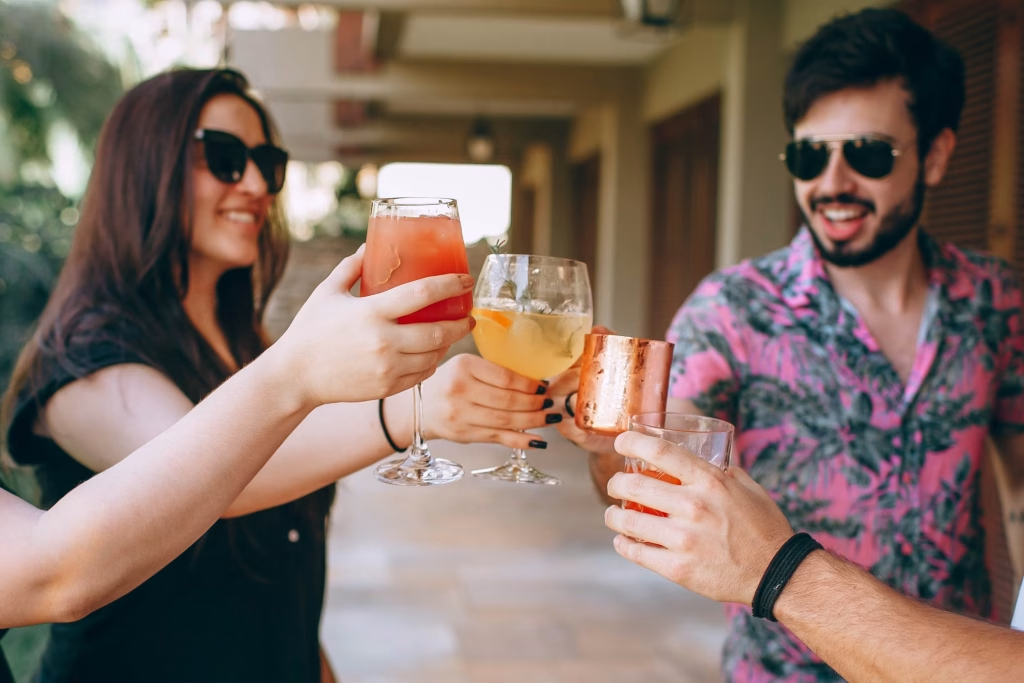
Get moving and have fun on NYC’s largest outdoor dance floor! Salsa, tango, rumba, and of course, disco – all under a ten-foot disco ball. This year, Social Dance at Lincoln Center is featuring a series of women DJs, all with their own style.
Las Karambas is an all-women band with members from Argentina, Spain, France, Venezuela, and Cuba. Their sound and rhythm include bolero, son, salsa, rumba, Hip-Hop and pop. Come dance and sing with Las Karambas!
The Dance Floor opens with DJ set at 6:30 pm Dance lesson at 7:00 pm Live music at 7:30 pm
Afterwards, stay for the Silent Disco at 10:00 pm
There are two ways to access this free event: 1. General Admission, first-come first-served. Just show up! 2. Fast Track opening the Monday before the event at noon.
Parade – n., a great show or display, a public procession
Demonstrate – v., to show clearly
Patriotism – n., love for one’s country
Reflect – v., to realize, to consider
Expat (Expatriate) – n., a person who lives in a foreign country
Embassy – n., the official residence and offices of an ambassador
Homesick – adj., longing for home and family while absent from them
Colonies – n., an area over which a foreign nation has control
Highlight – n., something which is especially interesting
Spectacular – adj., striking, sensational
On July 4th, Americans all over the world celebrate Independence Day. In the United States, it is a federal holiday, so many people don’t have to work. Parades, picnics, and barbecues take place during the day, with fireworks lighting up the sky at night. Americans demonstrate their patriotism on July 4th, reflecting on their freedom and the things they love about their country.
American expats living out of the United States still observe the 4th of July. American embassies all over the planet host parties and events. Individuals celebrate with their friends, and many get a little homesick.
The holiday marks the separation of the 13 colonies from the rule of Great Britain. The Declaration of Independence (the document) was completed on the 4th of July, 1776. But it was not signed until August!
A highlight of Independence Day in New York City is the evening fireworks display, this year to be held near the Brooklyn Bridge, on the lower East River. The spectacular display is the largest Independence Day celebration in the nation. For more information and where to watch the fireworks: https://www.timeout.com/newyork/things-to-do/where-to-watch-the-4th-of-july-fireworks
Sustenance — n., nourishment that maintains life, food.
potential — n., adj., able to come into being; possible
bountiful — adj., as much or more than is needed, abundant
mimic — v., to copy or imitate
approximately — adv., about, almost exact
Traditionally, people celebrated the return of light, life, fertility, and the potential for a good harvest on the summer solstice. The summer months bring a bountiful harvest and the foods served at solstice gatherings mimic the sun. Round, sun-colored fruits like lemons, oranges, peaches, and nectarines are the flavor of the day as well as vegetables like yellow squash, corn, and tomatoes.
Preheat the oven to 400ºF. Wash and chop the vegetables into approximately 1-inch pieces.
Spread the vegetables out over a large baking sheet (or two, if needed) so they’re in a single layer and not piled on top of one another. Drizzle the olive oil over top, then add the basil and a pinch of salt and pepper. Toss the vegetables until they’re evenly coated in oil and spices.
Roast the vegetables for 30-40 minutes, stirring once or twice (every 15-20 minutes or so), until the vegetables are soft and browned on the edges. Taste the vegetables and add another pinch of salt if desired. Sprinkle fresh chopped parsley over top just before serving.
I like to add an extra pinch of salt after roasting, so you get some salt sitting on the surface to give each bite a little pop. I also like to sprinkle with a little fresh parsley for freshness and to add a pop of color, but that’s optional.
We’re excited to share news about The Literacy Review, an annual journal that showcases powerful writing from adult literacy programs throughout New York City.
Each year, The Literacy Review brings together diverse voices and perspectives, providing a platform for writers from ESOL and ABE (Adult Basic Education) programs – including several students from our own program here at University Settlement.
The newest edition, Volume 23 (LR23),was recently released, and there was even a celebration for its launch at NYU.
April is known for many things: the start of spring, Arbor Day, as well as Easter & Passover. But did you know it’s also known as National BLT Sandwich Month and International Guitar Month 🤟🎸?
A B.L.T Sandwich ( Bacon, lettuce & tomato )Kirk Hammett – guitarist for Metallica
Here are a few more lesser known holidays to celebrate in the month of April…
The first Saturday of April is International Pillow Fight Day. “What is International Pillow Fight Day?” you ask. Read all about it here.
Sometimes getting dressed in the morning can be a challenge – no worries! On April 6th come to work/school in your pajamas for National Pajama Day.
No Housework Day on April 7th says it all. Take the day off from your household chores and rest; maybe watch a movie or drink some wine- do the dishes tomorrow, they can wait!
April 7th is also National Coffee Cake Day, so why not grab a cup of coffee to pair with this sweet treat. Not sure what coffee cake is? Check out this YouTube video and learn all about this deliciously mis-understood “breakfast” food.
Hug Your Dog Day is on April 10th – Show your dog some love with a big hug. Don’t have a dog, maybe consider adopting one!
National Siblings Day is on April 10th. If you have a brother or sister, reach out to them to send your love. If you don’t have a sibling, maybe consider volunteering with Big Brothers Big Sisters – “a mentoring organization that pairs adult volunteers with children to help them develop positive relationships and reach their full potential”.
National Pet Day 🐶🐱 is April 11th. Do you have a pet? Maybe you want another pet? Check out the ASPCA and adopt a new cat or dog today.
If you love bread and cheese, Grilled Cheese Day on April 12th is perfect for you. Check out this video on how to make the world’s greatest sandwich:
And finally, if you’re tired of all the music streaming services, maybe head to your local record store on April 20th for National Record Store Day. Check out this list of the top ten record stores in New York City.
New York City, as everyone knows, is a famous tourist destination. Some of its most well-known landmarks include the Empire State Building, Times Square, and Central Park.
This weekend, Lynne’s W1 class did an amazing job introducing the W2 and W3 classes to some other great, lesser-known places to visit in New York, including the Irish Hunger Memorial, the Noguchi Museum, Historic Richmond Town, the African Burial Ground, Federal Hall, Fraunces Tavern, Roosevelt Island, Green-Wood Cemetery, Dykeman House, the Eldridge Street Synagogue Museum, Gracie Mansion, the Merchant’s House Museum, and Castle Clinton.
Civil rights movement: n., actions between 1954 and 1968 taken to change laws of racial discrimination
Protests: n., a gathering of people who believe the same thing and want others to learn about it.
Abolish: v., to eliminate or stop something completely
Segregation: n., when all of one kind of people have to be together; for example, racial segregation.
Boycott: n., to stop buying or using something as a protest
Unconstitutional: adj., an act or belief that is not part of the ruling document of a country
Orator: n., someone who speaks powerfully and well
Martin Luther King, Jr. was an important leader in the civil rights movement in America in the ‘50s and ‘60s. He used peaceful protests to secure basic rights for people of color, including the right to vote. It was by nonviolent methods that he helped abolish the racial discrimination and segregation laws that were in place at the time. These laws ruled where people of color could sit or walk or even go to school.
His first efforts in the civil rights movement were inspired by the Montgomery Bus boycott. This began in 1955, when an African American woman named Rosa Parks refused to give up her seat on a bus for a white man, as the driver had told her to. Parks was arrested and fined. Subsequently, people of color refused to ride the buses at all, and this boycott continued for over a year. Eventually, the Supreme Court ruled that these laws were unconstitutional.
King went on to work hard helping people of color, changing many laws and attitudes in America. He became known as a great orator, and his speech “I Have a Dream” is one of the most famous in this country’s history. Martin Luther King, Jr. was assassinated when he was 39 years old, while still trying to improve the lives of others. We mark his birthday nation-wide as a federal holiday and try to increase our awareness of the racial problems that still exist in America.
Sign From Segregated Nashville Bus Number 351
Civil rights leader Martin Luther King Jr. addresses the crowd at the Lincoln Memorial in Washington, D.C., where he gave his “I Have a Dream” speech on Aug. 28, 1963, as part of the March on Washington.
The speech was ranked the top American speech of the 20th century in a 1999 poll of scholars. The speech has also been described as having “a strong claim to be the greatest in the English language of all time.”