Try these easy-to-bake cinnamon spiced pumpkin muffins as a snack. They’re perfect for Halloween!
Serves 12
Easy
Prep:
Cook:
Ingredients
225g all purpose flour
2 tsp baking powder
1 tbsp ground cinnamon
100g sugar
50g light brown sugar
200g pumpkin purée (about 1/2 standard 15 oz. can)
2 large eggs
125g salted butter, melted
Equipment needed:
12-hole muffin or cupcake pan
paper muffin/cupcake cups
2 bowls, one large, one medium
whisk
wire rack for cooling muffins
Method
Step 1: Preheat oven to 350. Place paper muffin cups in muffin pan. Mix the flour, baking powder, cinnamon, and both sugars together in a large bowl. Break up any lumps of brown sugar by rubbing them between your fingers.
Step 2: Whisk the pumpkin puree and eggs together in the smaller bowl, then add to the dry ingredients with the melted butter. Whisk for 2 minutes or so until just combined.
Step 3: Bake for about 15 minutes, until golden and puffed and a toothpick inserted comes out clean.
Cool completely on a wire rack. Will keep for three days in an airtight container.
violently – adv., to do something with force and anger
flourished – v., to thrive, to grow well
harmony – n., getting along, working together
tribes – n., groups of people who share a culture
throughout – prep., all over, everywhere
colonize – v., to take control of a new place
concern – n., caring, wanting someone to feel safe or feel better
dominance – n. control, authority
Indigenous – adj., being the people who originally lived in a region
proclaim – v., to announce for the public to know
resilience – n, able to recover quickly from difficulty
determination to preserve – expression, to have a firm goal to protect something
campaign – n., a series of planned actions to reach a goal
displacement – n, forced out of a home territory
assimilation – n., when minority groups absorb the characteristics of the dominant culture
What, exactly, is this day? It is a day to remember and honor the Native Americans, the people who lived here long before white settlers invaded and violently took their land.
Over 400 years ago, a peaceful society flourished in the Americas. The Native Americans lived with each other and in harmony with nature. They worshiped the earth and the sky, and took good care of their children and their elders. There were many different tribes of Native Americans throughout what is now the United States.
Europeans arrived after Columbus’ discovery of North America and soon colonized the new country. They did this without respect or concern for the people who were here before them. Terrible fights between the white people and the Native Americans led to white dominance over the lands that had belonged to the tribes.
President Biden, in 2021, became the first U.S. president to recognize Indigenous Peoples’ Day officially.
He proclaimed the second Monday in October as a day to honor Native Americans, their “resilience and strength” and determination to preserve “land, language, spirit, knowledge, and tradition,” even as they have faced a “centuries-long campaign of violence, displacement, assimilation, and terror,” he said.
Independence – freedom from another country’s rule
Colony – land controlled by another country
Fireworks – colorful explosions in the sky
Parade – a public celebration with marching bands and floats
Patriotic – Showing love, pride, and support for your country
Semiquincentennial – 250 year celebration
The 4th of July ( Independence Day ) is a national holiday in the United States. It marks the day the Declaration of Independence was adopted, on July 4, 1776, when the 13 colonies officially broke away from Great Britain.
These days, people celebrate it in all kinds of ways. Families and friends have barbecues or picnics, head to parades, spend the day at the beach or a park, or go to The Nathan’s Famous Fourth of July International Hot Dog Eating Contest in Coney Island.
Cities and neighborhoods decorate their neighborhoods in red, white, and blue, and people dress in patriotic colors. One of the biggest traditions is watching fireworks at night. For a lot of people, the Fourth feels like the start of summer!
This year, the United States is also celebrating its 250th birthday, the Semiquincentennial, marking 250 years since we gained our independence.
In New York City, this year’s celebration is especially large, with events honoring both the 250th anniversary and the 50th Macy’s Fireworks Spectacular. Fireworks are planned to launch from the Brooklyn Bridge, the Lower East River, and the Lower Hudson River, starting around 9:25pm.
Some 4th of July Activities in NYC
Macy’s 4th of July Fireworks Spectacular (around 9:25pm): Featuring over 85,000 fireworks and a new laser show from the Brooklyn Bridge.
Sail4th 250 (July 3rd to 8th): A massive maritimeprocession of over 70 tall ships and naval vessels in New York Harbor.
Times Square Ball Drop (July 3rd): For the first time, the New Year’s Eve ball will drop eight times to mark midnight in all US time zones, celebrating America’s 250th birthday.
Homecoming of Heroes Parade (July 6th): A parade in Midtown honoring veterans and first responders.
Fireworks Viewing Locations
Manhattan: Public viewing areas along the FDR Drive.
Brooklyn Bridge Park: Prime viewing for bridge-centered effects, requiring a free ticket issued by the city.
South Street Seaport: A prime spot for lower East River views.
Jersey City Waterfront: Exchange Place offers a full-day festival with views of the Hudson River show.
Rooftop Events: Special events are available at venues like Lost in Paradise Rooftop (Long Island City), Virgin Hotels NYC (Midtown), and Edge NYC.
(to) Honor (verb): To show deep respect or admiration for someone or something.
(to) Mourn (verb): To feel or express deep sadness, especially because of someone’s death.
(to) Serve (verb): To perform duties for a person, group, or country—especially in the military.
Communities (noun, plural): Groups of people living in the same area or having common interests.
Graves (noun, plural): Places in the ground where people are buried after death.
Recognition (noun): The act of acknowledging or honoring something or someone.
Solemn (adjective): Serious, respectful, and often sad or reflective in tone or mood.
Remembrance (noun): The act of remembering or honoring the memory of someone or something.
Marks (verb): Indicates or shows something significant; to signal or commemorate an occasion.
Unofficial (adjective): Not formally recognized or authorized, but commonly accepted or understood.
Associated with (verb phrase): Connected or linked to something in meaning, use, or relationship.
Memorial Day is a United States federal holiday for honoring and mourning military service members who died while serving in the U.S. Armed Forces. It is observed annually on the last Monday of May.
Originally known as Decoration Day, the holiday began on May 30, 1868, when communities decorated the graves of Civil War soldiers with flowers and flags. Although several towns claimed to be its birthplace, the holiday gained national recognition after General John A. Logan of the Grand Army of the Republic issued a proclamation establishing it, which lead to its nationwide observance.
In 1968, Congress passed the Uniform Monday Holiday Act, which moved Memorial Day from May 30 to the last Monday in May, creating a three-day weekend for federal employees.
Note the riderless horse, with boots turned backwards. This is a symbol of a fallen soldier, who will never ride again.
Today, Memorial Day is observed across the country through visits to cemeteries and memorials, the placement of flags and flowers on military graves, and community parades and ceremonies that honor fallen service members.
While it remains a solemn day of remembrance, Memorial Day also marks the unofficial start of summer, often associated with cookouts, retail sales, and travel.
circadian rhythm – n., our internal clock that keeps time by tracking light and darkness
biological – adj., relating to life or living things
rhythm – n., a regular pattern of movement or sound
protein – n., the building blocks of body tissue
hormones – n., chemical substances that act like messengers in the body
regulate – v., to control something
cluster – n., a group of things that are close together
hypothalamus – n., part of the brain that controls many bodily functions
genes – n., the basic units of heredity that carry your traits
organism – n., a living thing
sensitive – adj., showing a strong response to chemicals or other things in the environment.
blue light – n., the light that comes from sunlight and digital devices
miraculous – adj., something that is very surprising or lucky, like a miracle
Biological Clock Day is celebrated on April 28th. It’s a day to recognize the body’s natural ability to keep track of time, also known as the biological clock or circadian rhythm.
The biological clock is related to more than just aging.
For a start, both men and women have a biological clock, and all of this is celebrated by Biological Clock Day!
The biological clock acts as a sort of inner schedule by which a person lives that can often affect their behavior as well as their mood. Also known more formally as the ‘circadian rhythm’, this internal clock controls a sleep-wake pattern that fits in with the light and dark of a day according to the rhythms of the planet.
Proteins and hormones regulate the biological clock. Scientists are just now discovering exactly what makes us sleepy or wide-awake.
This internal clock is located in a tiny cluster of cells known as the suprachiasmatic nucleus (SCN). The SCN is in a part of your brain called the hypothalamus. Throughout the day, internal clock genes in the SCN send signals to control the activity throughout your body. The SCN is sensitive to light.
A biological clock is the body’s internal system that regulates sleep-wake cycles and other rhythms.
It’s made up of proteins that are turned on and off by thousands of genes.
A master clock coordinates all the biological clocks in the body.
The biological clock keeps working even when an organism is not exposed to natural light.
How can you support your biological clock?
Try to go to bed and wake up at the same time every day.
Avoid naps that make it hard to fall asleep at night.
Stop eating and exercising a few hours before bed.
Avoid caffeine and nicotine before bed.
Wear glasses that block blue light.
Biological Clock Day was established to celebrate the natural rhythms of the body and show appreciation for the miraculous way the human body is formed. The day is meant to raise awareness for the need that people have to pay more attention to what their bodies and brains are telling them.
culinary — adj, relating to cooking or the kitchen
occurence — n., an event, something that happens
cozy — adj., providing contentment or comfort
various — adj., of an indefinite number greater than one
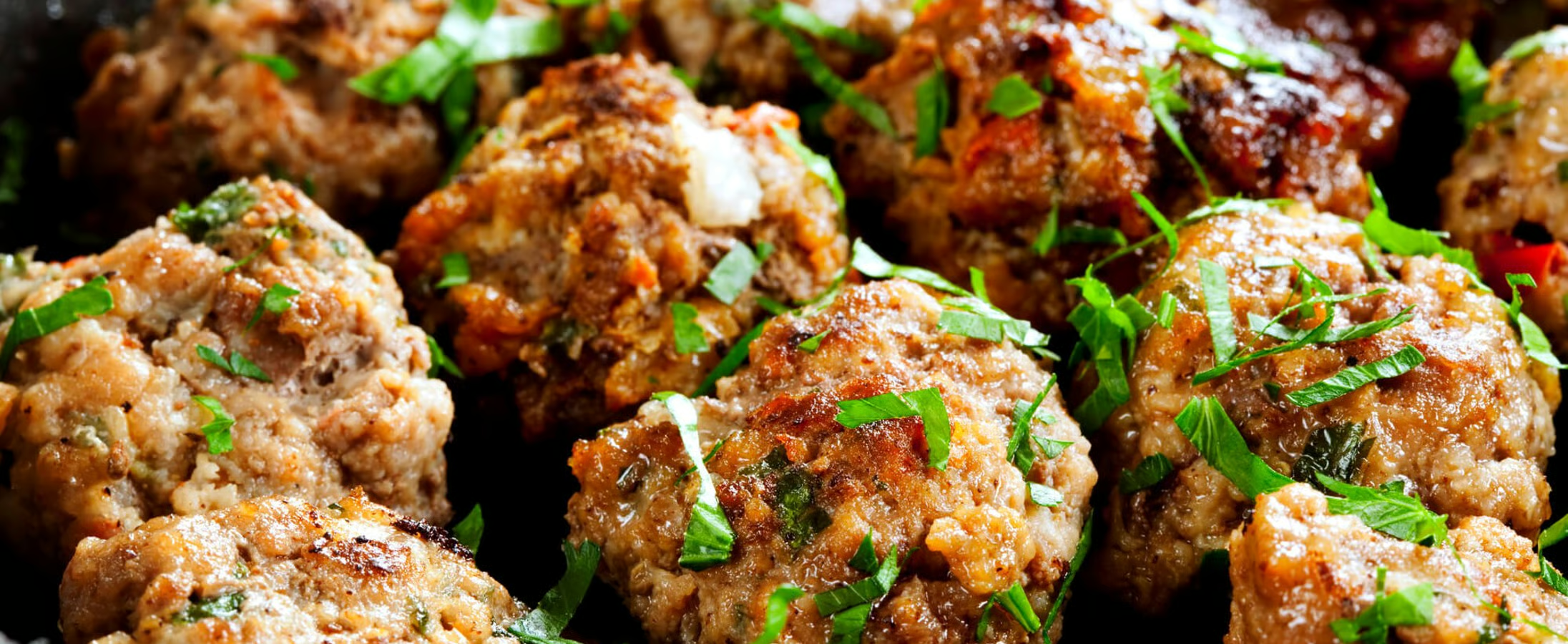
Juicy round balls of succulent meat, usually served with pasta, mashed potatoes or on their own — perfect for a cozy dinner at home!
Just the word, ‘meatball’ is enough to bring to mind great family meals for most people. These little balls of various meats can be found throughout the world in almost every culture.
Most people may associate them with Italian cuisine, though spaghetti and meatballs is actually an American dish. No matter your background, you can jump in and enjoy National Meatball Day!
How to Celebrate National Meatball Day
National Meatball Day, like other culinary holidays, should be enjoyed with your loved ones gathered around.
The most difficult part of preparing for National Meatball Day is going to be picking which nation’s recipe you will use. Luckily for you, this is a yearly occurrence, so you can pick a new nation to try each year if you like. Or you could be truly adventurous and try more than one at a time!
What is your favorite way to enjoy meatballs? There are so many ways to make them. Have you added them to your pizza or on a sandwich? Do you prefer to follow the traditions of your family or to try and create something new? This is the time to shine – an entire day devoted to meatball goodness!
And even if you’re not a meat-eater, there are plenty of veggie and vegan alternatives available, for example, chickpea koftas and tempeh, quinoa or black bean meatballs.
It doesn’t matter if you’re a chef or a first-time cook. Making a meal with meatballs is easy but makes you look like a star in the kitchen!
Tuesday, February 17th 2026 – Year of the Horse – the Fire Horse
Key vocabulary:
Marks(verb) – indicates or shows a particular event, change, or point in time.
Fresh start(noun) – a new beginning or opportunity to start over without the past affecting it.
Emphasizing(verb) – giving special importance or attention to something.
Prosperity(noun) – the state of being successful, especially financially or economically.
Symbolizes(verb) – represents or stands for something, especially through a symbol.
To ward off(verb phrase) – to prevent or protect against something harmful or unwanted.
Incorporates(verb) – includes or combines something as part of a whole.
Linked to(verb phrase) – connected or related to something.
Lunar New Year, also known as Chinese New Year, is a major holiday celebrated in many East and Southeast Asian cultures. It marks a fresh start, emphasizing themes of family, prosperity, and good fortune. Traditions include: a dinner on New Year’s Eve, exchanging red envelopes 🧧 with money to symbolize luck, cleaning and decorating homes with red banners and lanterns, 🏮 and vibrant community festivities like fireworks 🧨 and lion 🦁 dances to ward off evil spirits .
The holiday also incorporates the Chinese zodiac, with each year linked to one of twelve animals, such as the Rabbit, Dragon, or Tiger.
This year, Lunar New Year begins on Tuesday, February 17th. Celebrations often span up to 15 days, culminating in the Lantern Festival, which this year falls on Tuesday, March 3rd
Below are the twelve Chinese zodiac animals, including their associated years (1924–2043) and personality traits. What zodiac animal are you?