Hate crimes against members of the Asian American, Native Hawaiian, and Pacific Islander (AANHPI) communities increased by 73% during the COVID-19 pandemic nationally and nearly doubled in New York City from 2020 to 2021. Collective stress and trauma, mental health stigma, lack of resources, and other barriers to care make addressing the needs of these communities especially challenging.
DOHMH is eager to address the needs of this community by providing a learning initiative promoting their mental health and resilience. This 3-hour learning will cover a range of topics, such as AANHPI heritage in the US, challenges unique to these communities, identifying best practices for mental health care and resilience, and instilling hope. Its goal is to create a safe and supportive space for participants to discuss the effects of hate crimes, shame and stigma, and generational conflicts and to equip each other with coping strategies and resources.
The Promoting Mental Health in AANHPI Communities (PMH-AANHPI) learning workshop is designed to enhance participants’ awareness of culturally sensitive mental health resources that are available to all New Yorkers, including AANHPI communities and individuals.
1. The right to a high-quality orientation session, provided by your school district, that focuses on state standards, tests, and school expectations for ELLs, as well as the program goals and requirements for Bilingual Education and English as a New Language. This orientation must occur before final school program placement and must be in your preferred language.
2. The right to receive information about your children’s English language development, and also about their home language development if they are in a Bilingual Education program.
3. The right to meet with school staff at least once a year, in addition to other generally required meetings, to discuss your children’s overall learning and language development progress.
4. The right for your children to be placed in a Bilingual Education or English as a New Language program within 10 days of enrollment, and the right to opt out of a Bilingual Education program. At a minimum, your children must receive English as a New Language instruction.
5.The right for your children to transfer to another school in your district that offers Bilingual Education in your language, if your children’s original school does not offer such a program.
1. The school must give you an information meeting, called an orientation that tells you and other parents about the state tests and what schools expect from ELL students. The school must also tell you about the plans and needs for Bilingual Education (Ed) and ENL (English as a New Language). This orientation must be in your language and happen before your child is placed in his or her program.
2. The school must tell you if your child’s English is getting better, worse, or staying the same. If your child is in a Bilingual Ed. program, the school must tell you if his or her first language is getting better, worse, or staying the same. 3. You can meet with the teachers and/or other school workers a minimum of one time a year to talk about how your child is doing with his or her language learning. 4.The school must place your child in an ENL (English as a New Language) 10 days after school starts. You do not need to put your child in a Bilingual Ed. program if you do not want them in one. Your child must, at minimum, be in an ENL class.
5. You can put your child in another school in your district that can give him or her bilingual education in your family’s language if the first school does not have a bilingual education program.
The Coalition for the Homeless’ First Step Program is currently recruiting for its next free, in-person job training class that focuses on helping women prepare for careers in the Human Services field. The upcoming class will begin on Monday, September 5th and run through Friday, October 13th. The program takes place every weekday from 9:30 am – 3:30 pm over those six weeks in its offices at 129 Fulton Street in Lower Manhattan.
To begin the application process, please contact them directly by calling the First Step Hotline at 212-776-2074. From there, a member of their team will conduct a brief phone screening to ensure you meet the basic eligibility requirements and then sign you up for an information session to learn about the program in more detail. They will be running info sessions regularly from August 3rd through August 31st.
Bill of Rights for Parents of English Language/Multilingual Learners
Did you know that as an English language learner in NYC, you and your child have rights to a fair education? See the chart below for 5 rights NYC must provide for your little learner. On the left side of the chart, you’ll find exactly what is written on the official NYC government website for public schools. On the right side, you’ll find the same rights written, but hopefully in a way that’s a little easier to understand!
1. The right for your children to receive a free public education in the school district where you live, regardless of your or your children’s immigration status (e.g., whether your family members are citizens, immigrants, or undocumented) and the language that you or your children speak.
2 . The right to enroll your children in school without being asked to provide information or paperwork which may reveal your or your children’s immigration status. You cannot be asked to provide a social security card or number, an immigration visa or visa status, or citizenship documents or citizenship status.
3. The right under federal law to have a qualified interpreter/translator in your preferred language for critical interactions with the school district.
4. The right to have your children in a Bilingual Education (BE) program when there are 15 or more grade-level ELL students in grades K-8 with the same home language in one or two contiguous grades and 20 or more ELL students in high school with the same home language in one grade. If there is not a sufficient number of qualifying students in a school, but there are within its district, the district must provide a BE program.
5. The right to written notice, in English and your preferred language, that your children have been identified as ELLs and will be placed in a Bilingual Education or English as a New Language (formerly called English as a Second Language) program. [2]
1. Your children have the right to go to school near your home. (No matter your immigration status or what language you speak)
2. Your children can go to school. The school cannot ask for paperwork about their immigration status.
3. The law says that you must have someone who can speak your language for important moments with the school district. District- a part of a city or country, either an official area or one that is known for having a particular characteristic or business
4. Your child can go to school in a bilingual education program (a program of 2 languages). In these programs, 15 or more students must speak the same language. For high school, students must have 20 or more students with the same language. If the school doesn’t have a program like this, the school district must find one for you.
5.The school must write to tell you that your child has been tested as an ELL (English Language Learner) student and that they will be placed in a special class with other ELL students.
Did you know that there is something you can do to make you feel immediately more connected to your new home in New York City?
Did you know that this can also help you learn knew American English phrases and vocabulary- and it’s as simple as riding the train?
One more question:
How often do you look around at the billboards and advertisements in while you commute (1) around the city?
Learning to understand the way Americans speak and think is just as easy as looking at an advertisement (ad).
For example, the ad below for a food delivery service says, “New Yorkers aren’t angry, we’re just hangry“.
Hangry is a new casual English word that describes the feeling of being angry because you’re hungry!
Just by looking at this ad you’ve learned a word that you would not learn from school.
Look below!
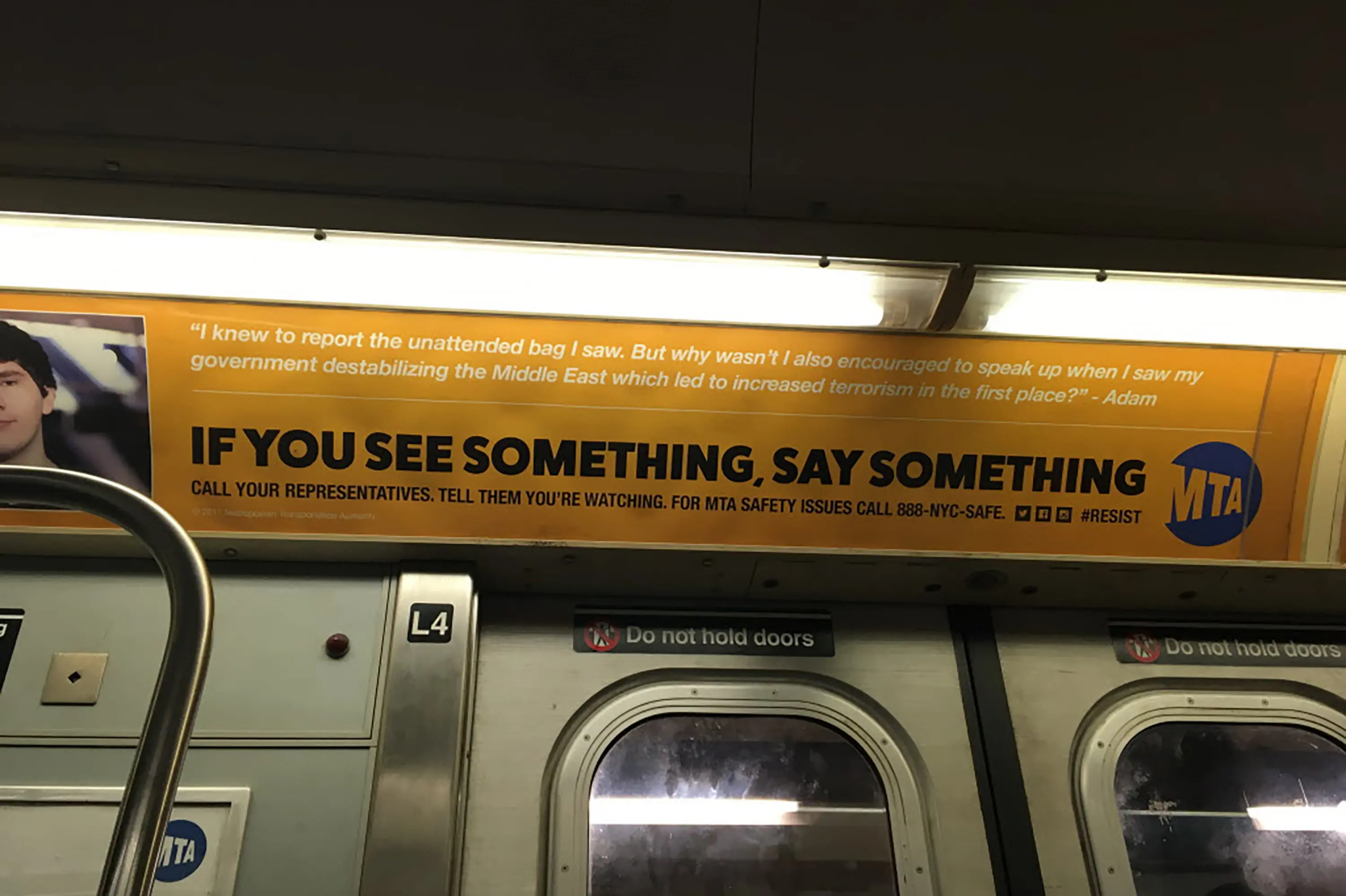
Do you recognize the train ad?
It is a popular slogan (2) in NYC that says, “If you see something, say something!”
This phrase simply means, that if you see something strange or dangerous on the train or anywhere in the city, you can call the number 888-NYC-safe to tell someone who can help you.
In the above example, we can learn new words, new ways of speech, and new information that can keep us safe!
Not only can you learn, popular words and phrases, but you can also learn valuable information about NYC and the resources it offers!
In the picture below, you’ll see an ad for NYC’s public college system- CUNY!
If you’ve ever dreamed of going to college, you can learn more information about how to go to college without spending a lot of money from this ad.
And if you didn’t already know the vocabulary, you’ll learn the words, apply, degrees, and debt.
How can you use ads to study on-the-go?
Go to the Google Translate app on your phone.
Choose your language.
Use the camera in the app to scan the ad- it will translate into whatever language you chose.
Translate the words and read the ad!
It’s as simple as that!
Next time you’re walking around your neighborhood or traveling between work and home, look at the ads around you!
You will learn new words, find things that can help you, and most importantly, you’ll feel a part of New York!
Vocabulary:
Commute– (v) to travel regularly by bus, train, car, etc. between your place of work and your home
Slogan– (n) a word or phrase used by a party, a group, or a business to attract attention.